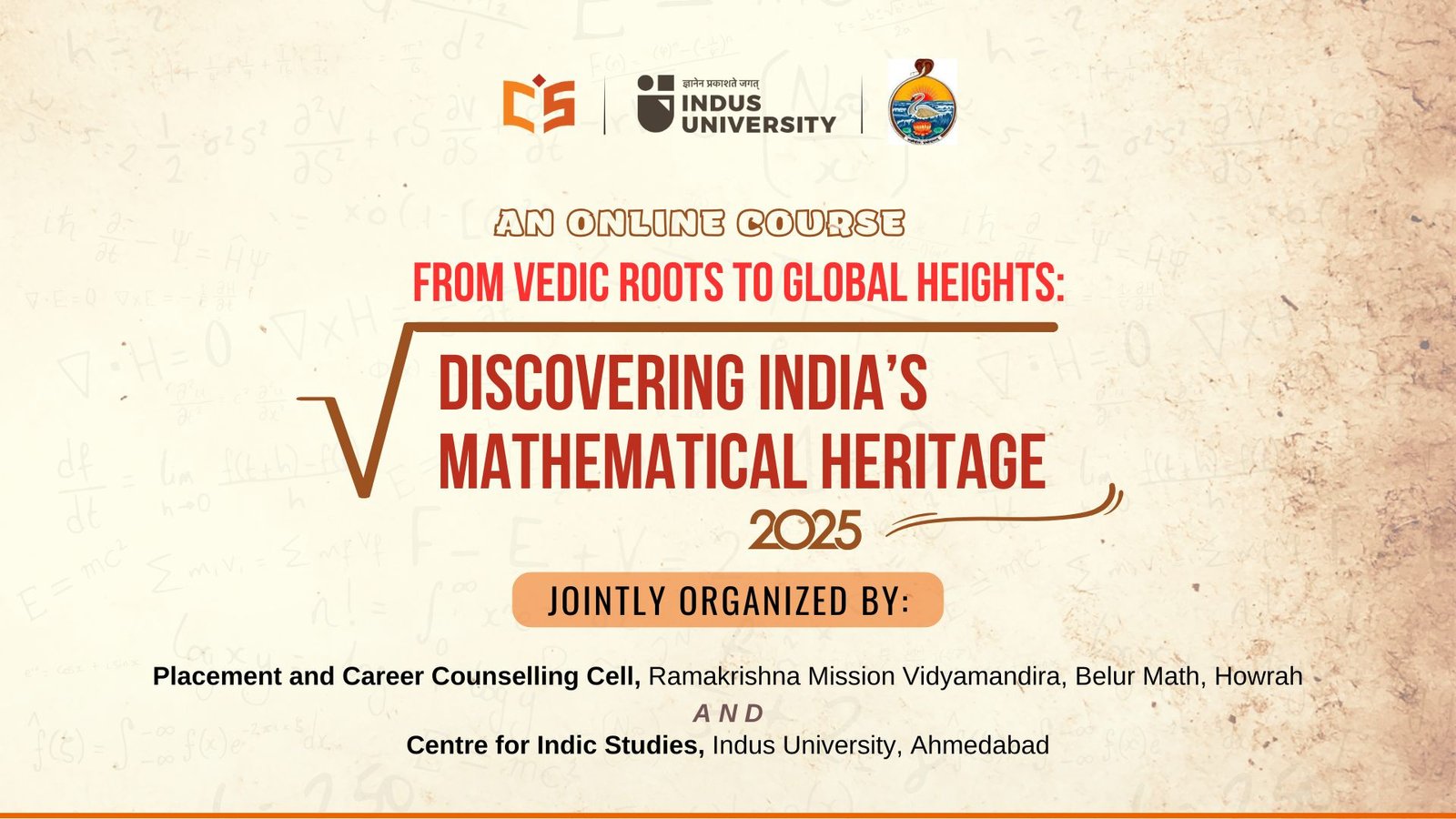
Mathematics in India has never been confined to numbers alone; it has been a way of perceiving order, harmony, and infinity within the universe. From early symbolic thinking and numerical representation to advanced explorations of geometry, combinatorics, and infinitesimals, India’s mathematical imagination evolved as an integral part of its intellectual and cultural life. This course invites learners to rediscover that journey- from foundational insights to their far-reaching global influence.
Jointly organized by Ramakrishna Mission Vidyamandira and Indus University, this online course explores the development and diffusion of mathematical thought in the Indian subcontinent. It highlights how numerical concepts, computational techniques, and theoretical innovations emerged within broader cultural and philosophical contexts and gradually travelled across civilizations, shaping global scientific traditions.
Moving from early number concepts and mathematical practices to advanced developments in arithmetic, trigonometry, permutations, and the study of the infinite, the course demonstrates the continuity and creativity of India’s mathematical heritage. Participants will also explore how these traditions continue to inspire modern problem-solving approaches and contemporary scientific thinking.
Through a blend of historical insight and conceptual clarity, this course seeks to connect the intellectual achievements of the past with present-day applications, encouraging learners to appreciate mathematics as a living and evolving civilizational legacy. The course bridges traditional mathematical concepts with modern applications, showcasing India’s contributions from arithmetic and algebra to trigonometry and calculus. With expert faculty from Indus University, participants gain an authentic understanding of India’s rich mathematical legacy. Designed for learners of all backgrounds, the program highlights how ancient wisdom continues to shape contemporary mathematical thought.
Important note: This course will be conducted as a structured lecture series in collaboration with Ramakrishna Mission Vidyamandira, Belur, West Bengal. Recorded sessions of all lectures will also be made available for enrolled students. Once enrolled, learners can access the lecture recordings and related materials at their convenience through the course portal.
This was a live course where the students attended the classes regularly conducted by the instructors from November 2025. Now, we have recorded videos of the whole session available here. If you want to go through the videos, you have to get enrolled in the course first. Next, you need to click on the “Take the Course”/”Continue Course option” from this page and then visit the “Recorded Video” section. Then, you can access the videos any time as per your convenience like the other self-paced courses available on our website.
What You’ll Learn
• The evolution of numerical systems in India and their transmission across cultures.
• The growth of mathematical thinking from early symbolic representations to advanced abstractions.
• The global impact of Indian mathematical ideas and their cross-civilizational influence.
• Key developments in computation, measurement, and analytical reasoning across time.
• Conceptual foundations underlying arithmetic, geometry, and trigonometric exploration.
• Methods of arrangement, combination, and coded reasoning developed in classical traditions.
• Early reflections on infinitesimals and the exploration of the infinite in Indian scholarship.
• Connections between classical mathematical insights and modern problem-solving techniques.
What You’ll Learn
• Online lecture sessions conducted by faculty associated with the Centre for Indic Studies, Indus University.
• Structured exposure to India’s mathematical heritage in a clear and accessible format.
• E-certificate upon successful completion of the course.
• Flexible learning access through scheduled online sessions and guided curriculum modules.
• An opportunity to engage with a wider academic community interested in Indic knowledge traditions and scientific heritage.